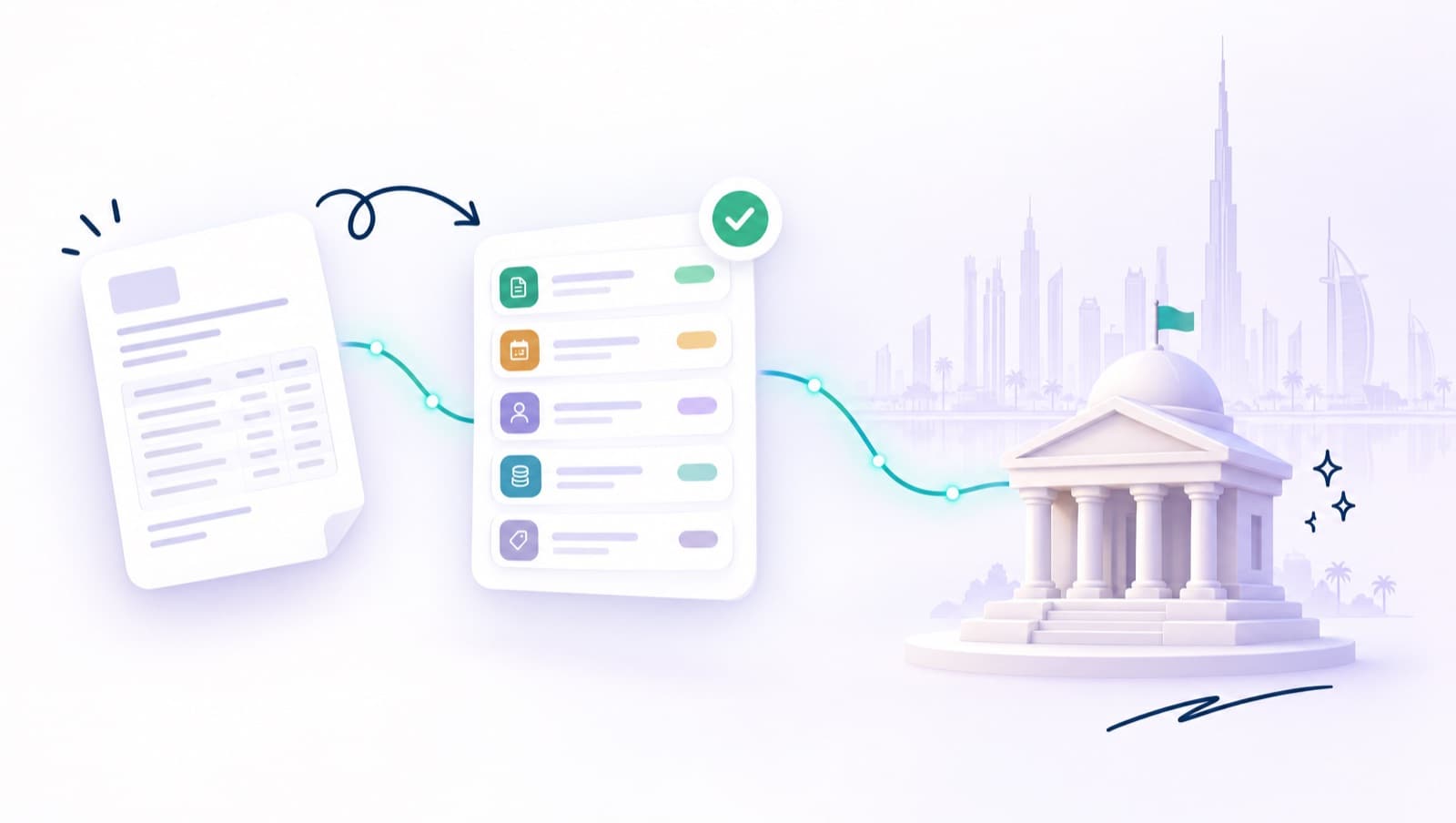
E-invoicing in the UAE becomes mandatory in 2027 for every business that sells to other businesses or to the government. If your revenue is AED 50 million or more, you must appoint an accredited service provider (ASP) by 30 October 2026 and go live on 1 January 2027. Below AED 50 million, the dates are 31 March 2027 and 1 July 2027. This guide explains UAE e-invoicing in plain English: what it is, who must comply, the deadlines and fines, how the system works and how to get ready, with links to the official texts.
Key facts
- Who: any person doing business in the UAE, for business-to-business (B2B) and business-to-government (B2G) transactions, VAT-registered or not, free zones included.
- 30 October 2026: businesses with revenue of AED 50 million or more must appoint an ASP. They go live on 1 January 2027.
- 31 March 2027: businesses below AED 50 million must appoint an ASP. They go live on 1 July 2027. Government entities go live on 1 October 2027.
- AED 5,000 per month, or part of a month, for failing to implement the system, including not appointing an ASP on time (Cabinet Decision No. 106 of 2025).
- 65 accredited ASPs on the Ministry of Finance list, consulted on 10 October 2026.
What is e-invoicing in the UAE?
E-invoicing in the UAE means issuing, sending and receiving invoices as structured data (XML in the PINT AE format) through accredited service providers on the Peppol network, with the tax data reported to the Federal Tax Authority (FTA). A PDF, Word file, scan or email is not an e-invoice under the Ministry of Finance rules.
The legal definition comes from Ministerial Decision No. 243 of 2025: an invoice "issued, transmitted, and received in a structured electronic format that enables automatic and electronic processing". The key word is structured. Every piece of information on the invoice (your tax registration number, your customer's, each line, the VAT amount, the total) sits in a named data field that your customer's software can read without anyone retyping it.
There are two kinds of e-invoice. A VAT-registered supplier issues an electronic tax invoice, which has 51 mandatory fields. A supplier that is not registered for VAT issues a commercial e-invoice, which has 49. Cancellations, price reductions, refunds and error corrections go through electronic credit notes; debit notes are not used. Our guide to what counts as an e-invoice, and why a PDF doesn't follows one invoice from start to finish, and the UAE e-invoicing requirements page covers fields, formats and record-keeping.
Five terms you will meet everywhere
| Term | What it means for you |
|---|---|
| ASP (accredited service provider) | The company, approved by the Ministry of Finance, that sends and receives your e-invoices and reports the tax data to the FTA |
| FTA (Federal Tax Authority) | The tax authority that receives the tax data from your ASP |
| TRN / TIN | Your tax registration number; its first 10 digits form your tax identification number, which identifies you on the network |
| Peppol | The international e-invoicing network and set of standards that ASPs use to exchange invoices |
| PINT AE | The UAE specification of the Peppol International invoice: the XML format and its fields |
Is e-invoicing mandatory in the UAE, and who must comply?
Yes. E-invoicing is mandatory for any person doing business in the UAE, for business-to-business (B2B) and business-to-government (B2G) transactions, whether or not the business is VAT-registered. Free zone companies are included. Sales to consumers (B2C) are excluded until the Minister of Finance decides otherwise, and no date has been announced.
The system covers "any person conducting business in the State" for every business transaction, unless the transaction is excluded. In practice:
- Mainland and free zone companies are in scope on the same terms, with the same deadlines.
- Businesses that are not VAT-registered are in scope too. They issue commercial e-invoices within 14 days of the transaction and need a tax identification number from the FTA.
- Both sides of the invoice must appoint an ASP: the supplier to send, the buyer to receive. One ASP handles both directions.
- Businesses that only receive invoices, such as holding companies with passive income or B2C-only businesses with revenue of AED 50 million or more, must still be able to receive e-invoices through an ASP, according to the Ministry of Finance FAQ.
- VAT groups: transactions between members of the same VAT group are in scope, with a 24-month grace period from 1 January 2027.
Ministerial Decision No. 243 of 2025 excludes a short list of transactions: sovereign government activities that don't compete with the private sector, international passenger flights with an e-ticket, airline ancillary services with an electronic miscellaneous document (EMD), international air cargo with an airway bill (for 24 months only), and VAT-exempt or zero-rated financial services. Being eligible for Small Business Relief under Corporate Tax does not take you out of scope. Our page on who must comply with the UAE e-invoicing mandate covers the edge cases (groups, non-residents, new companies) and ends with a quick decision list.
What are the UAE e-invoicing deadlines?
Businesses with revenue of AED 50 million or more must appoint an ASP by 30 October 2026 and go live on 1 January 2027. Businesses below AED 50 million must appoint one by 31 March 2027 and go live on 1 July 2027. Government entities must appoint one by 31 March 2027 and go live on 1 October 2027.
| Who | Appoint an ASP by | Go-live |
|---|---|---|
| Pilot and voluntary adoptionThe pilot programme (with businesses notified by the Ministry) and voluntary adoption both started on 1 July 2026. Penalties do not apply to voluntary adopters. | — | 1 July 2026 |
| Businesses with revenue of AED 50 million or moreThe ASP appointment deadline was moved from 31 July 2026 to 30 October 2026 by Ministerial Decision No. 66 of 2026. The go-live date did not change. | 30 October 2026 | 1 January 2027 |
| Businesses with revenue below AED 50 millionThis is the phase for most SMEs. | 31 March 2027 | 1 July 2027 |
| Government entities | 31 March 2027 | 1 October 2027 |
Source: Ministerial Decision No. 244 of 2025 (implementation phases) · Ministerial Decision No. 66 of 2026 (amends No. 244 of 2025) · Ministerial Decision No. 243 of 2025 (the e-invoicing system) · Checked 10 October 2026
Your phase depends on revenue, which Ministerial Decision No. 244 of 2025 defines as the gross income of your most recent accounting period, based on your financial statements (or other documents acceptable to the FTA). The first phase applies when that figure is equal to or above AED 50 million. The threshold only sets your timing: smaller businesses are not exempt, they simply start later.
The pilot programme, for businesses notified by the Ministry, and voluntary adoption have both been open since 1 July 2026. Going live before your date is allowed, and penalties don't apply to voluntary adopters.
If your revenue is AED 50 million or more and you have not signed with an ASP yet, treat 30 October 2026 as urgent. If you are an SME, 31 March 2027 is closer than it looks once you count the time needed to choose software, clean your data and sign a contract. The page on UAE e-invoicing deadlines and timeline explains how to apply the AED 50 million test and gives a month-by-month plan.
Are you ready for UAE e-invoicing?
Answer 9 questions (2 minutes): your phase, your personal deadlines, your 3 priority actions and a software recommendation.
What are the penalties for non-compliance?
Cabinet Decision No. 106 of 2025 (also called Cabinet Resolution No. 106) sets six fines. The main one is AED 5,000 for each month or part of a month that a business fails to implement the system, including failing to appoint an ASP on time. Late e-invoices and credit notes cost AED 100 each, capped at AED 5,000 per month.
| Breach | Fine | Cap |
|---|---|---|
| Failing to implement the e-invoicing system, including failing to appoint an accredited ASP on time | AED 5,000 per month | No monthly cap stated |
| Failing to issue and transmit an e-invoice on time | AED 100 per e-invoice | max AED 5,000 per month |
| Failing to issue and transmit an electronic credit note on time | AED 100 per credit note | max AED 5,000 per month |
| Issuer failing to notify the FTA of a system failure on time (within 2 business days) | AED 1,000 per day of delay | No monthly cap stated |
| Recipient failing to notify the FTA of a system failure on time (within 2 business days) | AED 1,000 per day of delay | No monthly cap stated |
| Issuer or recipient failing to notify its ASP of a change to the data registered with the FTA (within 5 business days of the FTA's confirmation) | AED 1,000 per day of delay | No monthly cap stated |
Cabinet Decision No. 106 of 2025 (violations and administrative penalties, e-invoicing) · Checked 10 October 2026
Three points are often misunderstood:
- Penalties start with your mandatory phase. They apply only from the date your business is required to implement e-invoicing. Voluntary adopters and pilot participants are not penalised before then.
- The notification deadlines are short. You have 2 business days to report a system failure to the FTA, and 5 business days to tell your ASP after the FTA confirms a change to your registered details. Each day of delay costs AED 1,000, and the supplier and the customer can each be fined for not reporting a failure.
- Other tax penalties still exist. The general VAT and tax procedure penalties can still apply to tax invoice failures, on top of the e-invoicing fines.
Read UAE e-invoicing penalties and fines, with worked examples, or estimate your own exposure with the e-invoicing penalty calculator.
How does UAE e-invoicing work? The 5-corner model
The UAE uses a "5-corner" model that the Ministry of Finance calls DCTCE (Decentralised Continuous Transaction Control and Exchange). Your software (corner 1) sends the invoice data to your ASP (corner 2), which delivers it over the Peppol network to your customer's ASP (corner 3) and customer (corner 4), and reports the tax data to the FTA (corner 5).
Unlike a PDF emailed to a customer, the invoice never leaves the system as a document. It moves as a data file between providers that have been tested and accredited by the Ministry. A few technical points are worth knowing, even if your ASP handles them:
- The format is XML, following PINT AE (version 1.0.4, published by OpenPeppol). UAE e-invoices carry no QR code.
- Your address on the network is based on your tax identification number, the first 10 digits of your TRN. Customers' TRNs therefore matter more than ever.
- Reporting to the FTA: the Ministry expects the tax data to reach the FTA in near real time, and batch submissions are also permitted. No separate legal deadline for this reporting has been published.
- Records: e-invoices and credit notes must be kept "within the State" for the periods set by the Tax Procedures Law, generally 5 years and 7 years for real estate. The Guidelines read this as data that can be retrieved in the UAE, wherever the servers are.
What changes in your day-to-day work
For most SMEs there is nothing to code. What changes is discipline. Every invoice needs complete customer data, including the TRN of VAT-registered customers. Mistakes are no longer fixed by editing and resending a PDF: you issue an electronic credit note. Supplier invoices arrive as data in your software rather than as attachments in a mailbox. And if a system failure stops you issuing or receiving e-invoices, someone in your team must know that the FTA has to be told within 2 business days. For the technical detail, read Peppol and PINT AE explained for UAE businesses.
What is an ASP, and which providers are accredited?
An accredited service provider (ASP) is a company approved by the Ministry of Finance to validate, send and receive e-invoices on the Peppol network and to report the tax data to the FTA. Every business in scope must appoint one. The official list counts 65 accredited providers (consulted on 10 October 2026).
The rules for providers changed on 1 October 2026, when Ministerial Decision No. 168 of 2026 replaced Ministerial Decision No. 64 of 2025. Three points matter to you as a customer:
- The pre-approval stage is gone. Providers that were only pre-approved had 30 days from 1 October 2026 to complete their accreditation, so the "pre-approved" part of the list is expected to change. Check that your provider appears as accredited on the day you sign.
- 100 free e-invoices a year. Every accredited ASP must provide 100 free e-invoice exchange and reporting services per year to each customer (Article 9 of the decision). The Ministry recommends checking that this allowance is written into your contract.
- Demanding accreditation criteria. ASPs must be Peppol-certified, hold ISO 27001 and ISO 22301 certifications and carry insurance. An accreditation lasts two years.
The providers on the list are a mixed group: software vendors such as Zoho, Tally, Wafeq, SAP and Focus Softnet; e-invoicing specialists such as ClearTax, Pagero, EDICOM and Comarch; and advisory firms such as Deloitte and EY. Browse, filter and compare the full list of accredited ASPs in the UAE.
Do you need new software, or just an ASP?
Usually you need both: accounting or ERP software that produces complete, accurate invoice data, and an accredited ASP that validates, sends and reports it. Some software vendors are accredited ASPs themselves; others connect to a third-party ASP. If your current software cannot pass structured invoice data to an ASP, plan a change before your deadline.
Think of it as two layers. Your accounting or ERP software creates the invoice and holds the data: customer TRNs, products, tax codes, credit notes, payments. The ASP checks that data against the UAE rules, carries it over Peppol and reports it to the FTA. An ASP alone does not fix incomplete customer records or an invoicing process run in spreadsheets.
| Your situation | What usually works |
|---|---|
| Freelancer or micro business that mainly issues invoices | Odoo with invoicing and accounting, or accounting software whose vendor is itself an accredited ASP, such as Zoho Books |
| Growing SME that also needs inventory, purchasing, CRM, several companies or e-commerce | An ERP connected to an accredited ASP, such as Odoo |
| Invoices made in Excel or Word | These are not e-invoices: move to invoicing software, or use a tool provided by an accredited ASP |
| Large company on an established ERP | A connector between your ERP and an ASP, usually set up with your integrator |
Odoo users: Odoo is expected to become an accredited ASP soon. It is not yet on the Ministry of Finance list. Until then, Odoo connects to an accredited ASP through a connector, and you can switch without changing software.
Compare the options in our UAE e-invoicing software comparison, which shows the official ASP status of each product, or start from the best accounting software in the UAE. If you are weighing up an ERP, our page on Odoo in the UAE explains when it fits and when another option may suit you better.
A word on who writes this guide: the site is published by Kenobiz Solutions LLC, a French-speaking Odoo partner in Dubai. We recommend software by explicit criteria and say so when another product is the better fit. You can read about us and our editorial rules.
How do you get ready? 10 steps
Confirm your phase and deadline, clean your customer and product data, check whether your software can produce UAE e-invoice data, choose and sign with an accredited ASP before your appointment date, connect and test, train your team, then go live and monitor rejections and notifications. Start early: data and habits take longer to fix than the technical connection.
- Confirm your phase. Check the revenue in your latest financial statements against the AED 50 million threshold, or take the e-invoicing readiness check.
- Map who you invoice and who invoices you. Separate B2B, B2G and B2C customers, free zone customers and foreign customers, because they are treated differently.
- Clean your master data. Customer legal names, TRNs, addresses, product descriptions, units and tax codes must be complete and consistent.
- Check your software. Ask your vendor whether it can produce the mandatory fields and how it connects to an accredited ASP.
- Shortlist and compare ASPs. Look at the price above the 100 free yearly services, connectors for your software, support hours and service levels.
- Sign before your deadline: 30 October 2026 or 31 March 2027, depending on your phase. Check that the provider is listed as accredited.
- Connect and test. Configure the link between your software and your ASP, then test standard invoices, credit notes, free zone customers and exports.
- Train your team. Corrections now go through electronic credit notes, the PDF is no longer the invoice, and system failures must be reported.
- Go live, ideally a few weeks before your mandatory date. Keep sending a regular tax invoice, such as a PDF, to customers who have not implemented e-invoicing yet.
- Monitor and notify. Watch for rejected invoices, report a system failure to the FTA within 2 business days, and tell your ASP within 5 business days of the FTA confirming a change to your registered details.
Our step-by-step e-invoicing implementation checklist details each step, with the questions to ask your software vendor and your ASP.
All our UAE e-invoicing guides
Each guide below goes deeper into one topic. You can also browse them by theme on the UAE e-invoicing guides page.
- What is e-invoicing? →A plain definition, why a PDF is not an e-invoice, and how one invoice travels through the 5-corner model.
- Who must comply →Scope of the UAE e-invoicing mandate: B2B and B2G, the AED 50 million threshold, free zones, non-VAT-registered businesses and exclusions.
- Deadlines & timeline →Every UAE e-invoicing date by phase, the 2026 extension, how to find your phase and a backward plan to 31 March 2027.
- Penalties & fines →The six e-invoicing fines under Cabinet Decision No. 106 of 2025, when they apply, three worked examples in AED and a calculator.
- ASP list →The official list of accredited e-invoicing service providers, searchable, with what changed under Ministerial Decision No. 168 of 2026 and how to choose one.
- Requirements →What a UAE e-invoice must contain, which format it uses, when it must be issued, and the notification and record-keeping rules.
- Peppol & PINT AE →How the Peppol network, the UAE 5-corner model and the PINT AE format fit together, in plain English for business owners.
- How to implement →A practical 10-step checklist to implement UAE e-invoicing, from your deadline and data audit to choosing an ASP, testing and monitoring.
- E-invoicing software →Which software can issue UAE e-invoices, which vendors are accredited ASPs, and what each option costs, checked against the official list.
- FAQ →Forty short, sourced answers about UAE e-invoicing, grouped by theme, with links to the detailed guides.
Got a specific question? The UAE e-invoicing FAQ answers the most common ones, and our AI assistant replies in your language with links to the official sources. This guide is general information, not tax or legal advice: for your own situation, check with an FTA-registered tax agent. Working across France and the UAE? See France e-invoicing 2026 vs the UAE.
Odoo is a trademark of Odoo S.A.
Frequently asked questions
Can I keep using my current accounting software?
Often, yes, if it can produce the structured invoice data the UAE requires (PINT AE) and connect to an accredited ASP, directly or through a connector. Ask your vendor two questions: which accredited ASP does it work with, and does it handle electronic credit notes? If the answers are unclear, plan a change of software well before your ASP appointment deadline.
Is a PDF invoice sent by email still valid after go-live?
Not as an e-invoice. The Ministry of Finance states that PDF, Word, image, scanned and emailed invoices are not e-invoices. During the transition, if your customer has not yet implemented e-invoicing, the Guidelines still require a regular tax invoice (for example a PDF) in addition to the electronic one.
Do I need an ASP if my business only receives invoices?
Generally, yes. Both the supplier and the buyer must appoint an ASP. The Ministry of Finance FAQ says that businesses which only receive in-scope invoices, such as holding companies with passive income or B2C-only businesses with revenue of AED 50 million or more, must still be able to receive e-invoices through an accredited provider.
Does e-invoicing apply to sales to consumers?
No, not for now. Ministerial Decision No. 244 of 2025 excludes business-to-consumer transactions until the Minister of Finance issues a decision saying otherwise, and no date has been announced. Your sales to other businesses and to government entities remain in scope.
How much does an ASP cost?
Each provider sets its own prices. What the law fixes is a minimum: every accredited ASP must provide 100 free e-invoice exchange and reporting services per year to each customer (Ministerial Decision No. 168 of 2026). Compare the price per invoice above that allowance, set-up fees and the connectors available for your software, and check that the free allowance is written into the contract.
Will the UAE e-invoicing deadlines be extended again?
The Ministry of Finance says no. When it moved the large-business ASP deadline to 30 October 2026, it called the change a targeted and final adjustment and said no further extensions would be granted. It reconfirmed the dates on 27 September 2026. Plan on the current dates.
Does Small Business Relief exempt me from e-invoicing?
No. Small Business Relief is a Corporate Tax election for resident businesses with revenue not exceeding AED 3 million. It does not change your e-invoicing obligations: if you sell to other businesses or to the government, you must still appoint an ASP and issue e-invoices from your phase date.
Can I start e-invoicing before my deadline?
Yes. Voluntary adoption has been open since 1 July 2026, alongside a pilot programme for businesses notified by the Ministry of Finance. Penalties do not apply to voluntary adopters, so going live a few weeks early lets you test with real invoices before your mandatory date.
Are you ready for UAE e-invoicing?
Answer 9 questions (2 minutes): your phase, your personal deadlines, your 3 priority actions and a software recommendation.
Related guides
- ASP listThe official list of accredited e-invoicing service providers, searchable, with what changed under Ministerial Decision No. 168 of 2026 and how to choose one.
- Penalties & finesThe six e-invoicing fines under Cabinet Decision No. 106 of 2025, when they apply, three worked examples in AED and a calculator.
- What is e-invoicing?A plain definition, why a PDF is not an e-invoice, and how one invoice travels through the 5-corner model.
- E-invoicing softwareWhich software can issue UAE e-invoices, which vendors are accredited ASPs, and what each option costs, checked against the official list.
Sources
Official texts and references used for this page:
- Ministry of Finance — UAE eInvoicing programme page — consulted 10 October 2026
- Ministerial Decision No. 243 of 2025 on the Electronic Invoicing System (MoF) — 2025
- Ministerial Decision No. 244 of 2025 on the implementation of the Electronic Invoicing System (MoF) — 2025
- Ministerial Decision No. 66 of 2026 amending Ministerial Decision No. 244 of 2025 (MoF) — 2026
- Cabinet Decision No. 106 of 2025 on e-invoicing violations and administrative penalties (MoF) — 2025
- Ministerial Decision No. 168 of 2026 on ASP eligibility criteria and accreditation (MoF) — 2026
- Ministry of Finance — list of accredited e-invoicing service providers (ASPs) — consulted 10 October 2026
- UAE Electronic Invoicing Guidelines, version 1.1 (MoF) — 1 June 2026
- UAE Electronic Invoice Mandatory Fields, version 1.0 (MoF) — 23 February 2026
- UAE eInvoicing Programme presentation (MoF) — 30 June 2026
- Ministry of Finance — FAQ (e-invoicing sections) — consulted 10 October 2026
- OpenPeppol — PINT AE specifications (Billing 1.0.4) — consulted 10 October 2026
Last reviewed: By Kenobiz Solutions editorial team
General information, not tax or legal advice. For your specific case, consult an FTA-registered tax agent.